

Six anonymous wallets were funded within 24 hours. Each one bet that the U.S. would strike Iran on a specific date — February 28, 2026. They were right. And together they walked away with $1.2 million.
Nobody’s been charged. Nobody’s been named. And here’s the uncomfortable truth: it’s not even entirely clear whether what they did was illegal. That’s the core problem Congress is now scrambling to fix — and it’s forcing a reckoning across the entire prediction markets industry.
What Prediction Markets Actually Are (and Why They’ve Exploded)
If you haven’t been paying attention to prediction markets, you may be surprised by how fast they’ve grown. Platforms like Kalshi and Polymarket let users buy and sell contracts based on the outcomes of real-world events — elections, Federal Reserve decisions, military actions, sports games, even whether specific words will appear in a politician’s speech.
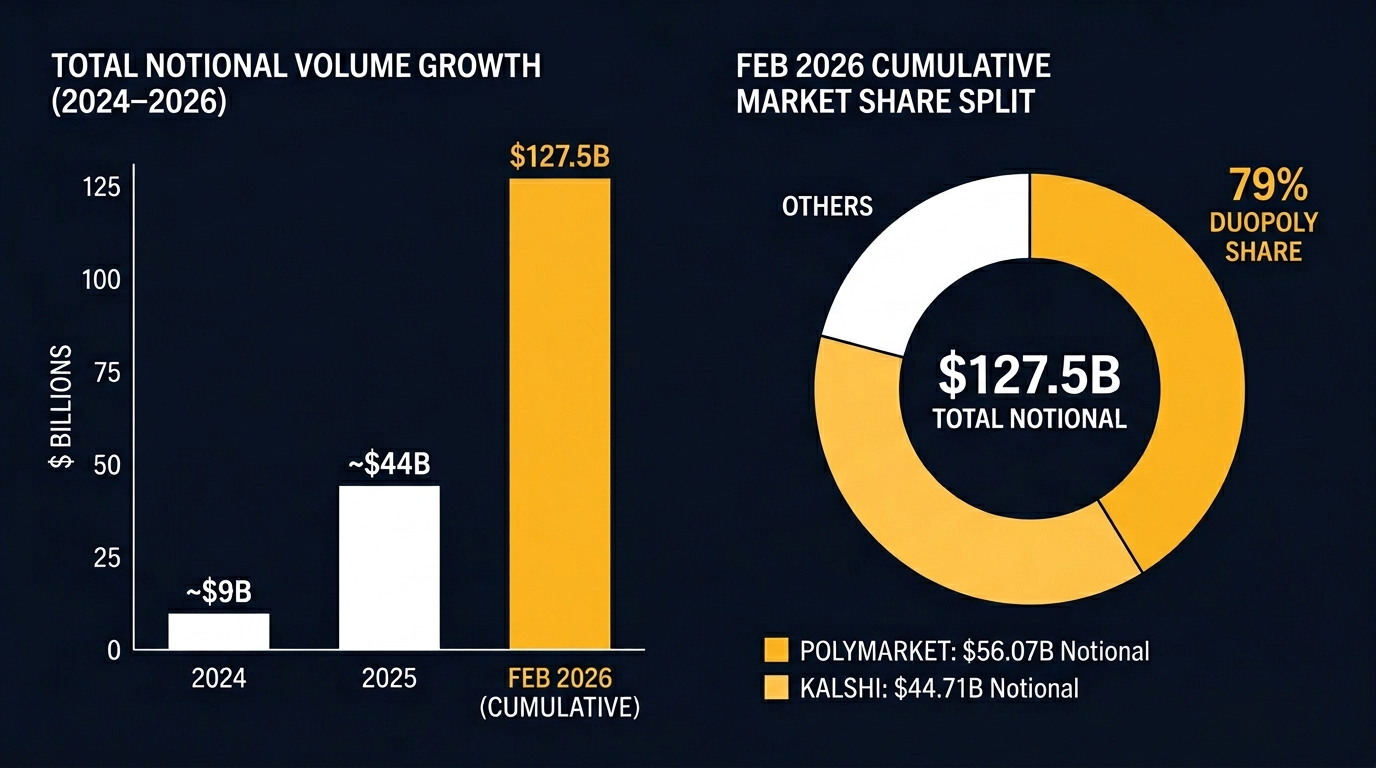
As of February 2026, the total notional trading volume across all prediction market platforms has crossed $127.5 billion, with Polymarket and Kalshi together accounting for roughly 79% of that activity. To put that in perspective: Polymarket’s total volume was around $9 billion in 2024. It’s not a niche experiment anymore.
Kalshi — the U.S.-regulated platform overseen by the Commodity Futures Trading Commission (CFTC) — processed over $50 billion in annualized trading volume in 2025 alone. Polymarket, which operates offshore and runs on the Polygon blockchain using USDC, has attracted traders from around the world with a more decentralized, lower-friction model.
These platforms have become, as Polymarket CEO Shayne Coplan described them on 60 Minutes, the most accurate forecasting mechanism available — often beating polls, pundits, and traditional market signals at predicting what happens next.
But that same accuracy has a dark side. If someone already knows what’s going to happen next, they have an enormous — and potentially illegal — edge.
The Two Trades That Changed Everything
Two incidents — just weeks apart — shifted prediction markets from a finance curiosity into a Congressional priority.
The Maduro Bet (January 2026)
A brand-new Polymarket account appeared in January 2026 and placed a single bet of over $30,000 that Venezuelan President Nicolás Maduro would be removed from office by the end of the month. A few hours later, the Trump administration conducted its surprise raid and capture of Maduro. The account cashed out over $400,000 in under 24 hours.
The timing wasn’t just suspicious — it was almost statistically impossible by chance. The account was newly created, had no history, and placed the bet in the narrow window before a tightly classified military operation. Rep. Ritchie Torres (D-NY) called it “shocking” and began drafting legislation the same week.
The Iran Strike Bets (February 2026)
Then came the Iran War. On February 28, 2026 — the day U.S. strikes on Iran began — blockchain analytics firm Bubblemaps identified six wallets that had collectively placed large bets predicting a strike on that exact date. Most of those wallets had been funded within the previous 24 hours. Together, they netted approximately $1.2 million.
Democratic Sen. Chris Murphy of Connecticut captured the public mood when he told reporters: “Nobody should be making bets on if the United States is going to war. Those are fundamentally corrupt markets, because there are people on the inside who know the answer.”
Is Prediction Market Insider Trading Actually Illegal Right Now?
Here’s where it gets complicated — and why Congress is moving quickly.
In traditional securities markets, insider trading is clearly defined: using material nonpublic information (MNPI) to trade stocks or options is illegal under SEC Rule 10b-5 and related statutes. But prediction markets are event contracts regulated by the CFTC under a different framework — and the legal doctrine hasn’t fully caught up.
The CFTC does have what’s known as the “Eddie Murphy Rule” (Rule 180.1), which bans insider trading using nonpublic information misappropriated from a government source. The rule was named after the 1983 film Trading Places, in which characters profit from a stolen USDA crop report. But applying this cleanly to a military operation or geopolitical decision involves legal theories that are, according to legal experts, still unsettled.
As Yesha Yadav, a professor of law and associate dean at Vanderbilt Law School, explained: “The challenge of prediction markets that we’re facing is that we don’t know when trading on insider information actually becomes insider trading.”
The distinction matters. A diligent researcher who correctly predicts a military strike through open-source intelligence hasn’t done anything wrong. A government official who places the same bet hours before signing off on the operation almost certainly has — but the legal theory to prosecute them is still being constructed in real time.
As of early March 2026, there have been no major insider trading arrests in the U.S. involving prediction markets. That legal vacuum is exactly what the new bills are designed to close.
Three Bills, One Goal: Closing the Loophole
Congress has moved unusually fast on this. Three pieces of legislation targeting prediction market insider trading have been introduced in 2026 — though their path to becoming law faces real political headwinds.
1. The Public Integrity in Financial Prediction Markets Act of 2026 (H.R. 7004)
Introduced by Rep. Ritchie Torres (D-NY) following the Maduro incident, this bill would bar federal elected officials, political appointees, executive branch employees, and congressional staff from trading on event contracts tied to government policy, government action, or political outcomes — if they possess or could reasonably obtain material nonpublic information through their official duties.
The bill has been co-sponsored by over 41 House Democrats, including former Speaker Nancy Pelosi, but has zero Republican co-sponsors so far. Torres remains optimistic about eventual bipartisan support, comparing it to the trajectory of stock trading ban legislation.
2. The End Prediction Market Corruption Act
Introduced on March 5, 2026, by Sens. Jeff Merkley (D-OR) and Amy Klobuchar (D-MN), this Senate bill takes a broader approach: it would ban the President, Vice President, and members of Congress entirely from trading event contracts on prediction market platforms. Senior executive branch officials would face restrictions as well.
Violators would face civil penalties starting at $10,000 per violation, with all profits from offending trades required to be repaid. The bill was introduced after consultation with Kalshi, which publicly expressed support for federal regulation and insider trading enforcement.
3. Senator Murphy’s Forthcoming Bill
Sen. Chris Murphy (D-CT) has announced a third piece of legislation targeting specific market categories — particularly those tied to war outcomes and so-called “mention markets,” where traders bet on whether politicians will say specific words in public speeches. No text has been released as of early March 2026.
For a broader look at how regulatory changes are reshaping financial markets, see our breakdown of how insider trading rules work across different asset classes.
What Kalshi and Polymarket Are Doing About It
The two dominant platforms have taken notably different postures in response to the legislative push.
Kalshi has been proactively cooperative. The company has already banned betting on war and death — a policy that created its own controversy when users complained that the platform didn’t count Khamenei’s removal as the Supreme Leader being “out” in a related market. Kalshi CEO Tarek Mansour publicly endorsed the Torres bill, stating, “insider trading is banned on Kalshi (and always has been).” The company also consulted with Sen. Merkley before the Senate bill was introduced, and issued a public statement supporting congressional action to police insider trading and keep prediction markets onshore under federal regulation.
Polymarket, by contrast, has not responded to multiple requests for comment from major news outlets. The platform operates offshore (though American users have accessed it via VPNs), removed a controversial nuclear detonation market after public outcry, and has not made public statements about the insider trading legislation. Polymarket’s U.S.-approved version — acquired through the $112 million purchase of QCEX in July 2025 — launched in beta in January 2026 with sports markets only and has a large waitlist.
The asymmetry isn’t just reputational. Kalshi’s regulated structure gives it a seat at the table in Washington. Polymarket’s offshore positioning leaves it more legally exposed if enforcement actions accelerate.
Will Congress Actually Pass Anything?
The honest answer: probably not soon — but the industry can’t afford to ignore the pressure.
All of the current legislative energy is coming from Democrats, who are in the minority in both chambers. Republicans control Washington, and the Trump administration has taken a generally friendly regulatory approach toward prediction markets. Sen. John Boozman (R-AR), the chairman of the Senate committee overseeing the CFTC, said he saw “some incidents that need to be looked at” but stopped well short of calling for hearings or fast-track legislation.
The CFTC, however, is a different story. The agency has signaled it is preparing new rulemaking, and the U.S. Attorney for the Southern District of New York has said his office is anticipating enforcement actions. Platform operators and legal experts are advising prediction market participants to operate as if enforcement is coming — because it likely is, even without new legislation.
For anyone building a business strategy around emerging financial platforms, our guide on navigating market trading in a changing regulatory environment lays out the key frameworks.
What This Means If You Trade on Prediction Markets
If you’re a retail trader using Kalshi, Polymarket, or any other prediction market platform, none of the current legislation targets you. The bills are specifically aimed at government officials who possess material nonpublic information through their official roles — not ordinary participants making their best predictions with publicly available information.
The practical guidance, according to legal firm Hodder Law, is straightforward: if you have access to information through a professional role or organizational relationship that is not publicly available, and you’re considering using it to trade on a prediction market contract tied to that information, you’re in legal risk territory — regardless of which platform you use or how the contract is structured.
For everyone else: the regulation is coming, the market is maturing, and the platforms most likely to survive this scrutiny are the ones building compliance infrastructure now — not scrambling after enforcement actions begin.
Prediction markets have moved faster than the laws designed to govern them. A $1.2 million Iran bet, a $400,000 Maduro windfall, and three competing bills in Congress have compressed years of regulatory debate into a matter of weeks. Whether or not legislation passes in 2026, the CFTC is watching, the U.S. Attorney’s office is watching, and the court of public opinion has already reached a verdict.
The window for prediction markets to self-regulate is closing. What happens next — in the courts, in Congress, and on the trading platforms themselves — will define what this industry looks like for the next decade.

Leave a Comment