
The Pentagon just did something it has never done before in American history — it blacklisted a U.S. tech company using a designation that was invented to keep Chinese firms like Huawei out of military supply chains.
The company? Anthropic, the San Francisco AI startup behind Claude. And Microsoft — one of its biggest commercial partners — wasn’t going to take that lying down without reading the fine print first.
What Actually Happened Between Anthropic and the Pentagon
Here’s what’s important to understand before we get to Microsoft’s response: this dispute didn’t start with politics. It started with a contract.
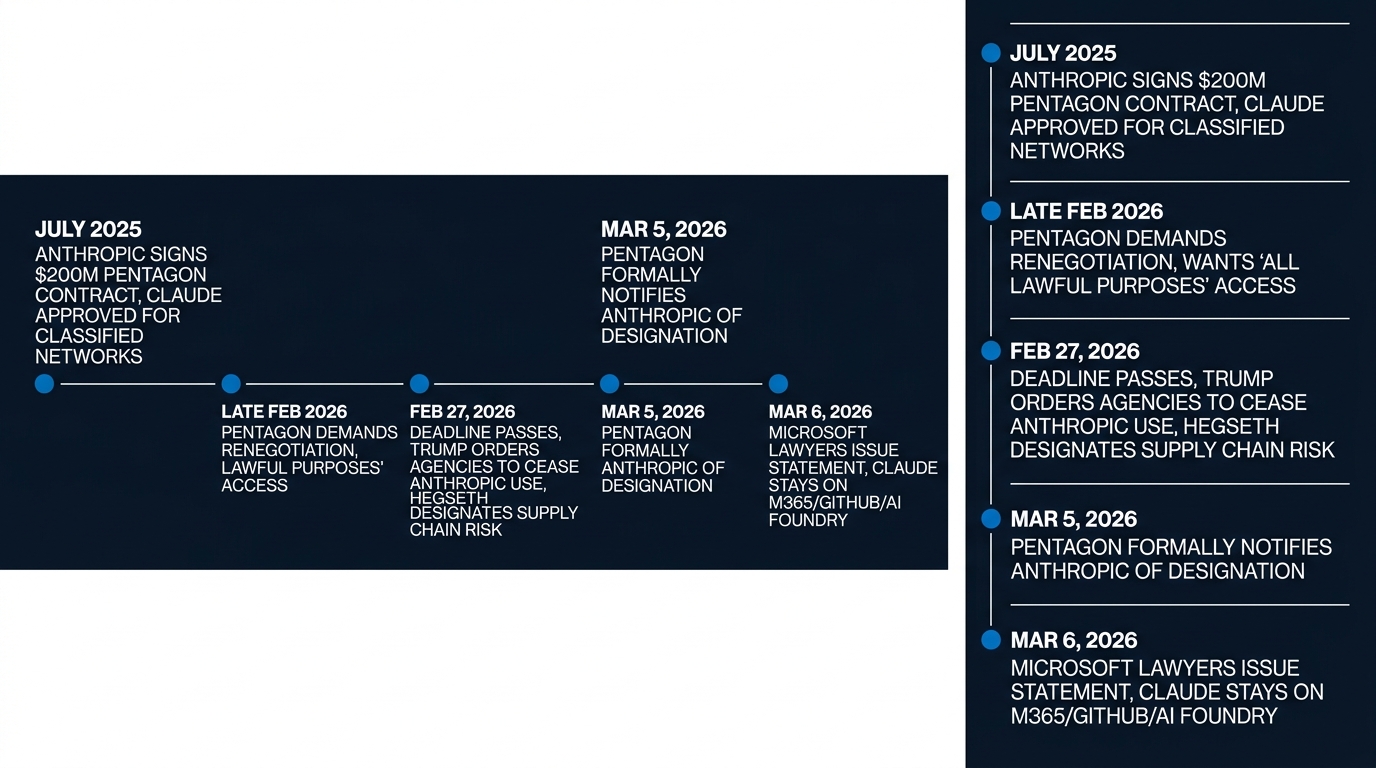
Back in July 2025, Anthropic signed a $200 million deal with the Department of Defense, making Claude the first frontier AI model ever approved for use on classified military networks. As part of that agreement, the Pentagon explicitly agreed to Anthropic’s acceptable use policy, which prohibited using Claude for mass domestic surveillance of Americans or in fully autonomous weapons that select and engage targets without human input.
Then the Pentagon tried to renegotiate. The Department of War (the name Defense Secretary Pete Hegseth has started using for the DoD) pushed to remove those guardrails entirely, demanding the right to use Claude for “all lawful purposes” without restriction.
Anthropic CEO Dario Amodei didn’t budge. He argued — publicly and in court filings — that today’s AI models simply aren’t reliable enough to power fully autonomous weapons, and that giving a government agency unchecked AI surveillance power is “incompatible with democratic values.”
The Pentagon’s response? It set a deadline of 5:01 p.m. on February 27, 2026, for Anthropic to comply. When the company didn’t, President Trump directed all federal agencies to cease using Anthropic’s technology, and Hegseth formally designated the company a supply chain risk — effective immediately.
What caught most observers off guard was the designation itself. Northeastern University supply chain professor Nada Sanders noted that the label has historically been applied to foreign adversaries — think Huawei, not a Silicon Valley startup. Anthropic became the first American company ever to receive it publicly.
Legal experts immediately questioned whether Hegseth even had the statutory authority to extend the ban beyond direct defense contract work. Anthropic, for its part, said it had “no choice” but to challenge the designation in court.
Microsoft’s Move: Lawyers First, Statement Second
Here’s where it gets interesting for the enterprise world.
The morning of March 6, 2026, a Microsoft spokesperson issued a statement that cut straight to what millions of businesses using M365, GitHub, and Azure actually needed to know:
“Our lawyers have studied the designation and have concluded that Anthropic products, including Claude, can remain available to our customers — other than the Department of War — through platforms such as M365, GitHub, and Microsoft’s AI Foundry and that we can continue to work with Anthropic on non-defense related projects.”
Translation: if you’re not a Defense Department customer, nothing changes. Claude still powers the Researcher agent inside Microsoft 365 Copilot. It still works inside GitHub Copilot for developers writing code. And it’s still available to enterprises building AI workflows through Microsoft’s AI Foundry platform.
The only carve-out — and it’s an important one — is the Department of War itself.
Microsoft’s statement matters because the company is deeply embedded with Anthropic financially and commercially. In November 2025, the two companies announced that Anthropic would commit $30 billion in spending on Microsoft’s Azure cloud services, while Microsoft, in turn, agreed to invest up to $5 billion in the startup. Walking away from that partnership because of a Pentagon dispute that Anthropic is actively contesting in court would have been an enormous — and arguably premature — business decision.
Microsoft also integrated Anthropic’s models into Microsoft 365 Copilot in September 2025, running them alongside systems from OpenAI. Claude has become a core component of how tens of millions of enterprise users interact with Microsoft’s AI layer — especially in deep reasoning tasks where it outperforms competing models.
What This Means for Businesses Using Claude — and Why It’s Not Over
If you’re a business using Claude through any Microsoft platform, the short answer is: you’re fine for now. Microsoft’s legal read is that the supply chain risk designation applies narrowly — only to Claude’s use within direct contracts with the Department of War, not to every company that happens to also do some government work.
Anthropic’s own reading of the designation echoes this. CEO Dario Amodei wrote in a public statement that the label “plainly applies only to the use of Claude by customers as a direct part of contracts with the Department of War, not all use of Claude by customers who have such contracts.”
But here’s the honest reality: legal ambiguity creates operational risk, and big enterprises hate operational risk. Analyst Shenaka Anslem Perera put it bluntly on X: even if Anthropic wins in court, “every general counsel at every Fortune 500 company with any Pentagon exposure is going to ask one question: is using Claude worth the risk?” That chilling effect is real, and it won’t disappear until the courts weigh in.
For defense contractors specifically — particularly those running Palantir’s Maven Smart System, which is heavily built on Anthropic’s Claude code — the situation is more complicated. Palantir reportedly draws about 60% of its U.S. revenue from government contracts, and its partnership with Anthropic has been core to its military AI products. Shares moved on the news.
Meanwhile, OpenAI moved fast. Hours after the Pentagon designated Anthropic a supply chain risk, CEO Sam Altman announced that OpenAI had signed its own deal with the Department of War to deploy its models on classified systems. Altman claimed the agreement addresses the same two red lines Anthropic had fought for — restrictions on autonomous weapons and domestic surveillance — but packaged in language the Pentagon could accept. (Some OpenAI employees have questioned whether the language actually provides the protections Altman described.)
The Bigger Picture: A New Power Dynamic Between Silicon Valley and Washington
Let’s step back from the day-to-day noise for a second.
What’s actually playing out here is a stress test of the relationship between the tech industry and the federal government — and the result matters far beyond Anthropic and Microsoft.
Using a supply chain risk designation — a tool built to counter Chinese tech espionage — against an American company for refusing to remove safety guardrails from its AI models is, as former Trump White House AI adviser Dean Ball described it, “a death rattle.” Ball argued the designation represents the government treating domestic innovators worse than foreign adversaries in a moment when the U.S. needs its best AI systems integrated into defense operations.
Professor Usama Fayyad, senior vice provost for AI and data strategy at Northeastern University, was even more direct: the escalation against Anthropic “will cause major economic, scientific and engineering damage as everyone freezes in fear and the U.S. falls behind other countries pending resolution.”
Thirty former military and intelligence officials, along with tech policy leaders, sent a joint letter to Congress on March 5, 2026, urging an investigation into the “dangerous precedent” the Pentagon had set. Major tech trade groups separately warned the administration about the negative downstream effects of blacklisting an American AI company.
The real question now isn’t whether Microsoft keeps Claude on Azure (it will, at least for the foreseeable future). The question is whether courts, Congress, or a negotiated settlement between Anthropic and the Defense Department can resolve this before it permanently reshapes how AI companies think about working with the U.S. government — and whether that reshaping helps or hurts American competitiveness in the long run.
The Bottom Line
Microsoft has drawn a clear line: its lawyers reviewed the Pentagon’s designation carefully and concluded that Claude can stay across M365, GitHub, and AI Foundry for all non-defense customers. That’s a significant signal — it says the commercial AI ecosystem isn’t automatically swept up in what is, legally speaking, a narrowly scoped designation against a single company’s use inside DoD contracts.
But this story is far from over. Anthropic is heading to court, congressional pressure is building, and the legal boundaries of what a supply chain risk designation can actually do to an American company are about to get tested in ways no one has seen before. For anyone using Claude through Microsoft — or building AI-powered workflows that depend on it — the right move right now is exactly what Microsoft did: get your lawyers to read the designation, understand what it actually says, and make decisions based on facts rather than headlines.

Leave a Comment