

Every school year, millions of students open laptops and use artificial intelligence tools — often with zero guidance, zero policy, and zero plan. Meanwhile, countries like South Korea and Singapore are already embedding AI literacy into national curriculums. The U.S.? Still patching together state-by-state patchworks.
This isn’t a technology problem. It’s a strategy problem. And the longer the gap stays open, the more it costs — in student outcomes, workforce readiness, and global competitiveness. Here’s why AI in education requires a national strategy right now, and what that actually looks like in practice.
The Size of What We’re Actually Dealing With
Let’s start with the numbers, because they make the stakes very real.
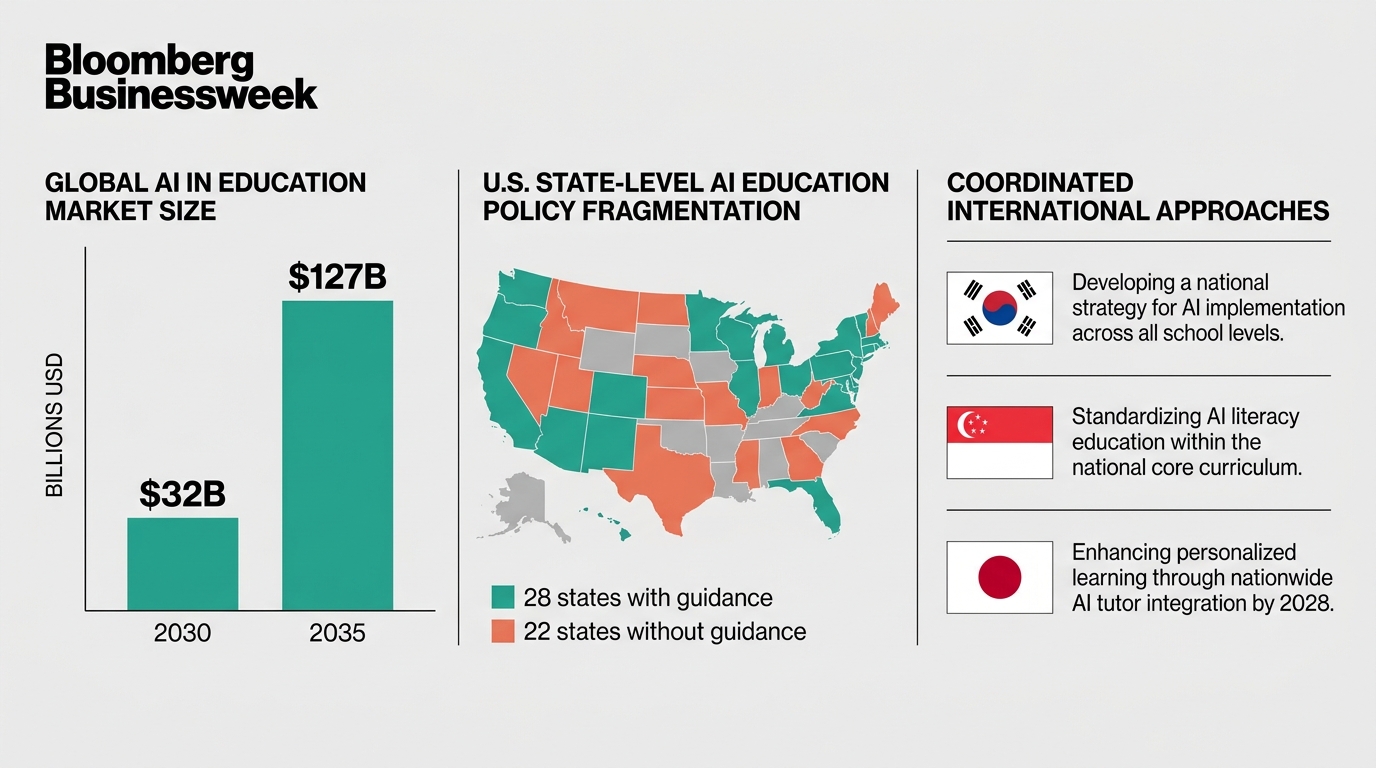
The global AI in education market — spanning K–12, higher education, and corporate training — is projected to grow to somewhere between $32.27 billion by 2030 and $127.2 billion by 2035, driven by surging demand for personalized learning, adaptive assessments, and AI-powered tutoring. That’s not a niche sector quietly growing in the background. That’s a market transformation happening in real time, inside every classroom that has a Wi-Fi connection.
On the demand side, AI tools aren’t optional extras anymore. According to Udemy’s 2026 Global Learning and Skills Trends Report, AI-related enrollments have surged fivefold in a single year, surpassing 11 million globally. Every minute, five to eight people sign up for an AI course on the platform alone. Students, professionals, and business leaders are all racing to catch up — because they already sense what the data confirms: executives estimate that nearly half of current workforce skills will be irrelevant within a few years.
And yet, when it comes to a coherent, federally-led framework for how artificial intelligence tools should be integrated into schools — the kind of framework that actually scales — the U.S. is still improvising.
28 States Have AI Guidance. That’s Not a Strategy.
You might be thinking: states are handling it. And technically, yes — as of April 2025, at least 28 states have published some form of AI guidance for K–12 settings, according to the Education Commission of the States. That’s real progress from the zero-state baseline when ChatGPT launched in late 2022.
But guidance is not a strategy. And 28 different approaches to the same problem isn’t coordination — it’s fragmentation.
Some states are building curricular frameworks for AI literacy. Others are focusing almost entirely on student data privacy and FERPA compliance. A handful — California, Connecticut, Texas — are creating oversight boards and “regulatory sandboxes” where AI tools can be tested before full rollout. Meanwhile, rural districts in the same states are still figuring out basic device access.
The gap between well-resourced urban districts and underfunded rural or low-income schools isn’t closing. In many cases, uncoordinated AI adoption is widening it. When affluent schools can afford the latest adaptive learning platforms and underserved schools can’t, you don’t get equity — you get a two-tiered education system baked into the technology layer.
As the Federation of American Scientists put it in a 2025 report: the challenge isn’t defining innovation. It’s implementing it effectively. And implementation at scale requires federal alignment, not 50 parallel experiments.
What Other Countries Are Already Doing
Here’s where it gets uncomfortable. The U.S. tends to think of itself as the global leader in AI technology — and at the frontier research level, that’s still largely true. But when it comes to integrating AI into education systems at a national level, several other countries are ahead.
South Korea unveiled a plan in 2023 to integrate AI deeply into its public school system, with AI coursework embedded into the national curriculum across all grade levels by 2025, starting at high school. Every student gets access to a personalized AI tutor. Homework and assignments adapt in real time to each student’s learning behaviors and tendencies.
Singapore launched a national initiative specifically to build AI literacy among both students and teachers. Its ‘Smart Nation’ strategy aims to position the country as a global AI leader by 2030 — with education reform as a core pillar, not an afterthought. By 2026, AI training is offered for teachers at every level of the system, including those still in training.
Japan’s AI Strategy, established back in 2019, called for AI integration across the entire education system — years before the generative AI wave made the topic unavoidable.
These aren’t bigger economies than the U.S. They’re more aligned ones. The difference isn’t resources. It’s strategy.
The U.S. Has the Pieces — They Just Aren’t Connected
To be fair, the federal government hasn’t been completely silent. In April 2025, President Trump signed an executive order — “Advancing Artificial Intelligence Education for American Youth” — establishing a White House Task Force on AI Education, a Presidential AI Challenge for students, and a framework for public-private partnerships in K–12 AI education.
Separately, a $23 million National Academy for AI Instruction was launched, backed by Microsoft, OpenAI, and Anthropic, and led by the American Federation of Teachers. The goal: give K–12 teachers hands-on training, tools, and ongoing support to implement AI responsibly in classrooms.
Congressman Vince Fong introduced the NSF AI Education Act of 2025 to fund scholarships, fellowships, and regional Centers of AI Excellence at community colleges — specifically targeting rural and underrepresented communities.
So the pieces exist. What’s missing is the connective tissue. These initiatives operate in parallel rather than as a unified system. There’s no national framework tying AI literacy standards, teacher training pipelines, equity benchmarks, and district-level implementation support into one coherent whole.
For context on why this matters at a workforce and business level: LinkedIn’s 2025 Workplace Learning Report found that nearly half of talent development leaders are already seeing a skills crisis, with organizations under acute pressure to build AI capability in their teams. The students entering the workforce over the next decade will define whether the U.S. closes or widens that gap.

What a Real National Strategy Actually Looks Like
Critics of federal involvement in education will push back here — and fair enough. Education in the U.S. is intentionally decentralized, and that local control serves real purposes. A national strategy doesn’t mean a federal mandate for how every classroom runs. It means a shared infrastructure that states and districts can plug into.
Based on what’s working in both leading U.S. states and internationally, a functional national AI education strategy would include four elements:
1. Readiness assessments before funding distribution. States and districts need to know where they actually stand before deploying AI tools at scale. The Federation of American Scientists recommends requiring readiness reviews — evaluating educator preparation, device access, and data infrastructure — before large-scale rollout. This protects taxpayer investment and stops the cycle of costly failed ed-tech deployments the U.S. keeps repeating.
2. National AI literacy standards. Right now, a student in Connecticut might graduate with a strong foundation in responsible AI use while a student in an underfunded rural district never gets near the topic. National standards — not mandated curriculum, but shared benchmarks — would create a baseline every student can reach, regardless of zip code. UNESCO published guidance for generative AI in education in 2023. The U.S. needs its own version, adapted to scale.
3. A serious teacher training pipeline. The research here is unambiguous: the most successful AI integrations in schools happen when teachers lead them. Teacher-controlled tools outperform student-facing AI deployed without educator support. The $23 million National Academy is a start, but it needs to be a component of something larger — a continuous, adequately funded professional development system tied to real outcomes, not one-off training sessions.
4. Equity-first implementation tracking. Federal and state agencies should require AI education vendors in publicly supported programs to report outcomes broken down by student subgroups. If adaptive learning tools are improving outcomes for affluent suburban students while widening gaps for students with disabilities or English language learners, the system needs to catch that in real time — not in a five-year review.
The Cognitive Risk Nobody Is Talking About Enough
There’s one more dimension to this that deserves its own paragraph, because it’s being underweighted in most policy discussions.
A 2025 MIT study tracked what happens in students’ brains when they reach for ChatGPT too early in a problem-solving task. When AI was used from the outset, brain activity shifted toward shortcutting rather than exploratory thinking. Students still finished the work — often faster — but the outputs were blunter, less original, and showed fewer signs of deep reasoning. The patterns associated with creativity and genuine problem-solving went quiet.
This isn’t an argument against AI tools for learning. It’s an argument for thoughtful, structured integration — which requires, again, a strategy. Automation tools amplify human capability when humans know how to use them intentionally. The same principle applies in education. AI as a crutch produces brittle thinkers. AI as a scaffold — used at the right moment, in the right way — can accelerate genuine learning.
That distinction requires teacher expertise, institutional guidance, and yes, a policy framework that helps districts make those calls consistently.
2026: The Year Pilots Become Habits
Industry observers are calling 2026 the year AI moves from classroom experiment to daily infrastructure. If 2023–2025 were the “panic and pilot” years, 2026 is when habits harden — good or bad.
That makes right now the highest-leverage moment for policy action. The patterns being set in districts today will be difficult and expensive to reverse later. The equity gaps that open up in the next 18 months will compound over the next decade of workforce development. The countries locking in national AI technology frameworks now will have a structural advantage in developing AI-capable graduates that persists for a generation.
A national strategy for AI in education isn’t idealism. It’s infrastructure — the same kind of infrastructure argument the U.S. made for rural electrification, for broadband expansion, for any prior technology that required public coordination to reach everyone rather than just those who could already afford it.
The question isn’t whether AI will transform education. It already is. The question is whether that transformation will be equitable, intentional, and globally competitive — or chaotic, uneven, and reactive.
The U.S. has the talent, the investment, and now the political will to move on AI education. What it needs is coordination. A national strategy doesn’t mean Washington controlling classrooms — it means building the shared foundation that lets every school, every teacher, and every student actually benefit from the most powerful artificial intelligence tools ever developed.
The window to get this right is open. But it won’t stay open indefinitely. The countries and states moving with intention right now are already pulling ahead.

Leave a Comment