

A startup nobody outside Korea had heard of three years ago is on track to clear $100 million in annual recurring revenue — and its fuel isn’t productivity, it isn’t enterprise software, and it definitely isn’t another AI coding assistant. It’s loneliness.
That’s not a cynical read. It’s the honest economic story behind wrtn, the South Korean AI company quietly building one of the most-engaged entertainment platforms on the planet. And if you want to understand where the next wave of consumer AI money is going, this is the story worth paying attention to.
What Is wrtn — And Why Have You Never Heard of It?
Founded in Seoul in 2021, wrtn started as a humble chatbot aggregator — essentially a wrapper that let users access multiple AI models in one place. Not exactly a world-beater concept. But the team made a pivot that changed everything: they rebuilt the product around interactive storytelling.
Today, wrtn operates under two brand names: Crack in South Korea and Kyarapu in Japan. The product is best described as a cross between a choose-your-own-adventure novel and a tabletop RPG — except the dungeon master is an AI generating your story, characters, images, and audio in real-time based on your choices.
CPO Dong-jae Lee describes the experience as having “a writer designated for you.” You step into a pre-built universe, make choices as a protagonist, and the AI ghostwrites the narrative on the spot. It’s somewhere between consuming a story and playing a game — and for millions of users across Korea and Japan, that combination is deeply sticky.

How sticky? Reports show that Kyarapu’s top 10% of users clock 1,343 minutes per month on the platform — that’s nearly 45 minutes a day, every day, from their most engaged cohort. The company has over 5 million monthly active users and closed 2025 with $70 million in annualized revenue. It is now targeting $100M+ in 2026, $700 million by end of 2027, and is eyeing an IPO as early as 2028.
The Loneliness Epidemic Is a Real Market Force
Martell Hardenburg, a partner at VC firm Antler and a backer of wrtn, is candid about what’s driving demand. “There’s a bit of a loneliness epidemic, right?” he told Fortune. “How can AI help with that?”
He’s not wrong — the data is stark. A 2025 AARP study found that 4 in 10 U.S. adults aged 45 and older report feeling lonely — a significant jump from 35% in 2010. Among younger Americans, the numbers are worse: 61% of people aged 18–25 describe themselves as “seriously lonely,” according to Pew Research. A quarter of Americans say they don’t have a single person they can confide in.
The U.S. Surgeon General has compared the health impact of chronic social isolation to smoking 15 cigarettes a day. The UK, U.S., and Japan have all formally identified loneliness as a public health crisis. This isn’t background noise — it’s a structural demand signal for products that make people feel seen, heard, and engaged.
And AI entertainment is positioning itself squarely in that gap. A Harvard Business Review analysis found that therapy and companionship — not productivity — are the top reasons people use generative AI tools. Before coding help. Before writing assistance. Before search. People are using AI to feel less alone. If you’re still on the fence about whether AI tools are worth it for your business, this data point alone is worth sitting with.
How wrtn Avoids the Companion App Trap
Here’s where wrtn’s product strategy gets interesting — and why it might have a longer runway than character chatbot competitors like Character.AI or Replika.
Companion apps face a very specific regulatory and reputational problem: users form emotional attachments to AI personas, sometimes to a degree that causes real harm. The AI companion market has faced scrutiny from regulators in both the U.S. and China, and has been linked to high-profile incidents involving teen mental health. China is now considering rules requiring human operators to intervene in extreme circumstances. If your own brand uses AI-powered outreach or ads, building a responsible advertising strategy is no longer optional.
wrtn’s founder Lee Seyoung argues that the narrative-centric model sidesteps this. In wrtn’s universe, characters can disappear or be replaced as the story evolves — there’s no persistent AI “relationship” to become dependent on. Users are immersed in a story, not a friendship. The attachment is to the experience, not to a simulated person.
“Users aren’t just chatting with a character,” Lee told Reuters. “They are entering a narrative world where they are the protagonist.”
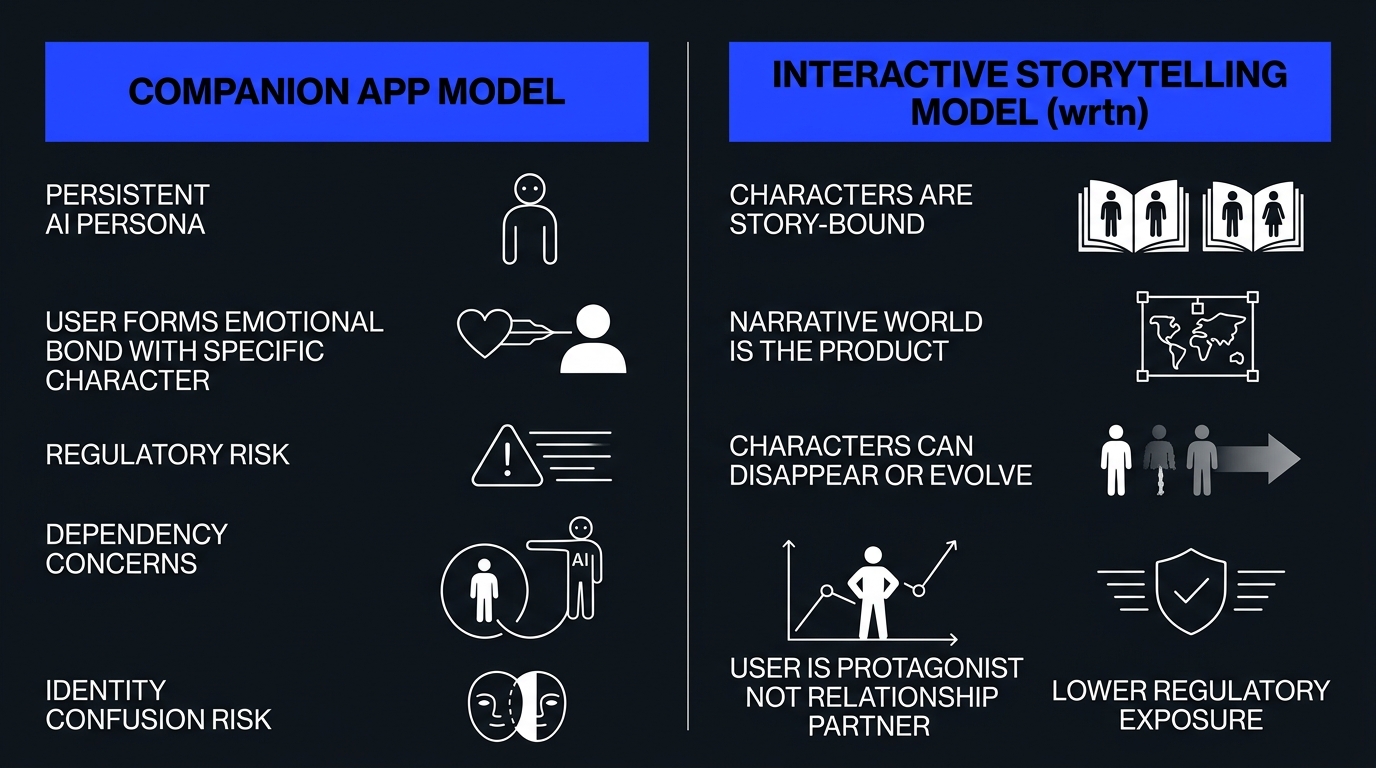
It’s a meaningful distinction — and one that positions wrtn more like Netflix or a video game than like a digital therapist or surrogate friend. That framing matters for regulators, investors, and users alike.
Why Asia Is Ahead on This Curve
Hardenburg’s thesis goes beyond wrtn specifically. He believes Asia — and Korea in particular — will be the origin point for the defining company in AI entertainment. “We believe a generational company will come out of Asia, because it has that heritage of gaming, social networks, and creating content,” he told Fortune.
There are structural reasons to take this seriously. South Korea has a deeply embedded gaming culture, a sophisticated content industry (see: the global K-drama and K-pop explosion), and one of the highest smartphone penetration rates in the world. It also has a looming demographic problem — a falling birthrate and aging population — which is pushing companies to automate emotional and relational experiences as much as logistical ones.
South Korea’s semiconductor exports hit a record $173.4 billion in 2025, driven by AI chip demand. The government is running an elimination-style competition — dubbed the “AI Squid Game” by media — to develop a sovereign AI foundation model. The ecosystem supporting AI entrepreneurship in Korea right now is serious.
Japan is equally relevant. The phenomenon of hikikomori — extreme social withdrawal — has been studied there for decades. The country is acutely aware of loneliness as a social force. Kyarapu’s success there isn’t coincidental; it’s culturally resonant.
What the $100M ARR Story Actually Signals
If you’re watching AI purely through a productivity lens — AI for work, AI for coding, AI for enterprise — you’re looking at half the map.
Consumer AI entertainment is becoming its own category, and it’s being driven by something more primal than efficiency: the need for connection, narrative, and escape. The AI companion market is projected to reach $140 billion by 2030, according to Grand View Research. Character.AI’s average user has 25 sessions per day, spending about 1.5 hours daily in-app — numbers that dwarf most social platforms.
wrtn’s approaching $100M ARR without a U.S. launch yet. That launch is planned for mid-2026. The company is building Hollywood storytelling integration and English-language localization into its roadmap. When it lands in the most lonely developed nation on the planet — where a quarter of adults have nobody to confide in — the market will be waiting.
The question for founders, investors, and anyone thinking about where consumer AI is heading isn’t whether this category is real. wrtn proved it is. The question is what the responsible version of it looks like — and who builds that before the regulators force the issue. Understanding how to position yourself in an AI-driven market is the practical next step.
AI entertainment isn’t a niche. It’s what happens when the loneliness epidemic meets a technology that can scale human-feeling experiences at near-zero marginal cost. wrtn figured that out in Seoul. The rest of the world is catching up.
If you’re building in consumer AI — or investing in it — the signal here is worth taking seriously: emotional engagement isn’t a soft metric. It’s the whole business model. And if you’re questioning whether digital marketing is actually worth your investment in this environment, the answer looks very different when AI entertainment is the product.


Leave a Comment